


You’ve done your homework on academics.
You’ve checked that every school on your list has your intended major. You’ve looked at class sizes, campus resources, graduation rates. You’ve made sure your GPA and test scores are in the ballpark for admission.
You’re thinking about the academic side. Most families are.
But here’s what you might not be considering: Can you handle college-level academic rigor while essentially becoming a professional athlete?
Because both sides get significantly harder at the same time.
The time management gap
In high school, you practice for 90 minutes to 2 hours after school. Maybe you lift in the morning a few days a week.
You’ve figured out how to balance school and sports. You’re managing both successfully.
In college, the athletic commitment looks completely different.
During spring season: Morning lift, afternoon conditioning, evening practice. At least two of the three, and sometimes all of them, five or six days a week.
That’s before you get into the team meetings and film study.
During fall season: less running and lifting, but now you have two games a week. Plus travel. Not 20-minute bus rides to the next town over. Overnight trips. Missing classes. Catching up on work in hotel rooms.
NCAA research shows college athletes spend an average of 28-33 hours per week on athletics during season - more than double what most high school players experience.
The time available for academics shrinks dramatically right when the academic rigor increases.
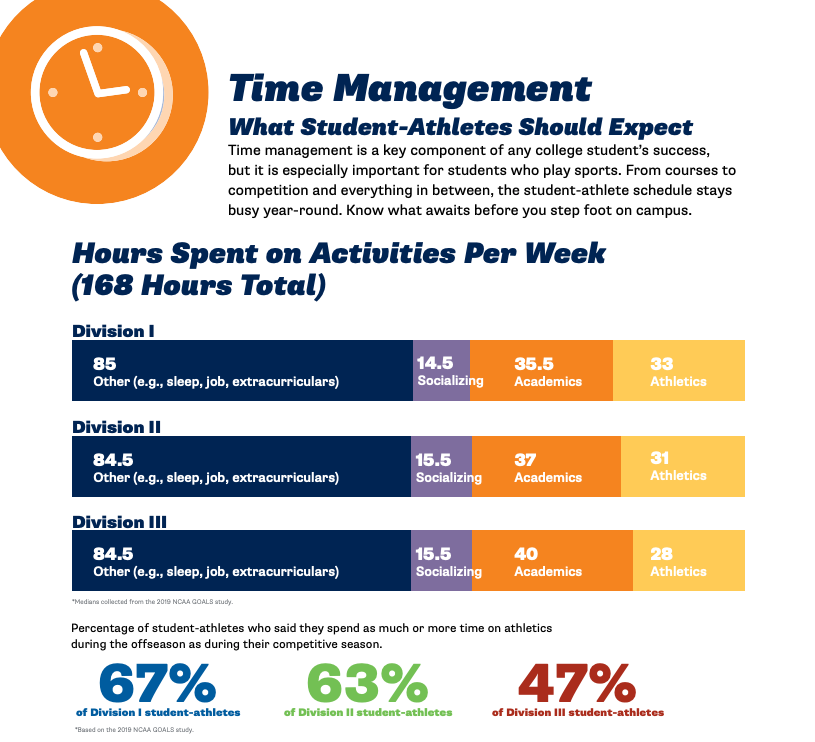
Both sides get harder at once
The academic workload in college is harder than high school. This is true for everyone.
But whereas some high school athletes quit sport altogether or play recreationally in college, NCAA field hockey players are also dealing with a giant leap in athletic workload.
What families don’t always consider is that both increase simultaneously.
You’re not just stepping up academically while maintaining your current athletic level.
You’re not just stepping up athletically while maintaining your current academic level.
You’re stepping up both at once. While living away from home for the first time. While managing your own schedule. While dealing with roommates, social pressures, and everything else that comes with being a college freshman.
Some high achievers can compartmentalize and manage it all. They’ve built strong time management skills. They can handle the pressure.
But not everyone can. And assuming you’ll figure it out when you get there is risky.
When the hockey gets hard
Here’s a version of this problem most families don’t anticipate:
You’re keeping your grades up in high school while field hockey is going well. You’re confident. You’re playing a lot. You’re successful.
Then you get to college.
You’re a freshman. You’re not playing as much as you expected. The gap between high school field hockey and college field hockey is massive.
You’re struggling athletically. That’s normal for freshmen. But it affects everything else.
Can you keep your academics on track when the hockey part gets really hard?
Because the two are connected. When one falls apart, the other often follows.
And unlike sports with professional paths, field hockey players need the degree. You're building a career, not using college as a stepping stone.
The questions to consider
When you’re researching schools, you’re already asking about academics. You’re checking majors, looking at requirements, making sure you’re academically admissible.
But are you also asking:
Can I handle this academic workload while playing Division I field hockey?
Do I have the time management skills to succeed here when both demands increase?
Am I being realistic about my capacity, or just ambitious about my goals?
There’s a difference between pushing yourself out of your comfort zone and setting yourself up to fail.
The bottom line
Athletic fit gets you recruited.
Academic fit determines whether you succeed and stay.
Most families are already thinking about academics. That’s good.
But make sure you’re thinking about academics in combination with the athletic demands of being a college field hockey player.
Because both get harder at once. And that combination is what determines whether you thrive or just survive.
Coming next in Thursday’s paid newsletter: The specific questions to ask about academic support and accountability, how to evaluate if you’re academically matched, and what to look for that tells you whether a program is academically sustainable.
If you’re actively recruiting right now and want answers faster than waiting for weekly newsletters, The Recruiting Advisor might be useful. It’s an AI tool trained on everything I teach - answers your questions 24/7, in real time. $29/month, 7-day free trial.