

The National Indoor Tournament is this weekend.
High pressure. Lots of coaches. Games every couple of hours across multiple courts.
And somewhere between your first and second game comes a thought that tanks your performance.
Here’s how it happens.
You have a rough first game. Maybe you misplace a few passes. Maybe you don’t get many touches or minutes. Maybe the pace feels faster than you expected, and you’re a step behind.
Walking off the court, your brain starts: “The coaches just saw me at my worst. I’m blowing it.”
Three hours later, you’re back on Court 3 for Game 2. But now you’re playing scared. You don’t want the ball. You’re playing not to make mistakes instead of playing to make an impact.
You think you’re blowing it, so you play scared. And now you actually are blowing it.
This happens at every major recruiting event. One bad performance creates a thought. The thought creates consequences. And the consequences are worse than the original performance ever was.
There’s a framework that can help you interrupt that spiral.
The ABC framework
It’s called the ABC framework, and it comes from cognitive behavioral therapy:
A: What ADVERSITY did you face?
B: What were your BELIEFS about it?
C: What were the CONSEQUENCES?
The adversity is the thing that happened. The belief is the story you tell yourself about what it means. The consequence is what you do next.
Most people skip straight from A to C without realizing that B - the belief - is doing all the damage.
How this shows up in performance
A few years ago, I asked a teenage athlete - a forward - who was struggling with confidence to answer those three questions after a tough practice.
Here’s what she wrote:
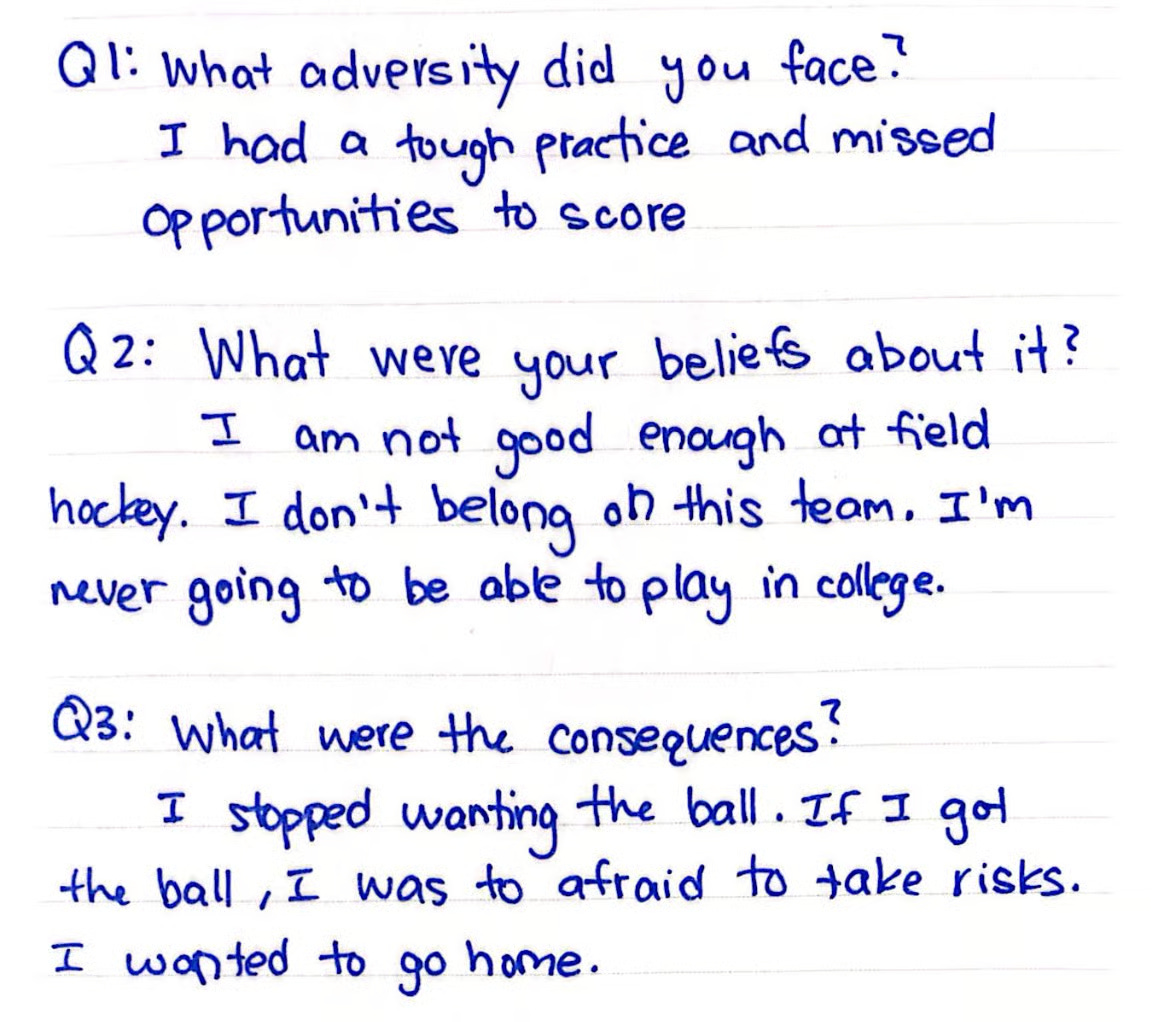
After she finished the exercise, I didn’t offer any advice. Yet.
Instead, I asked her to read it back when she got home that night and write a “reflection on the reflection” the next day, after she’d slept on it.
This time, her tune had changed:
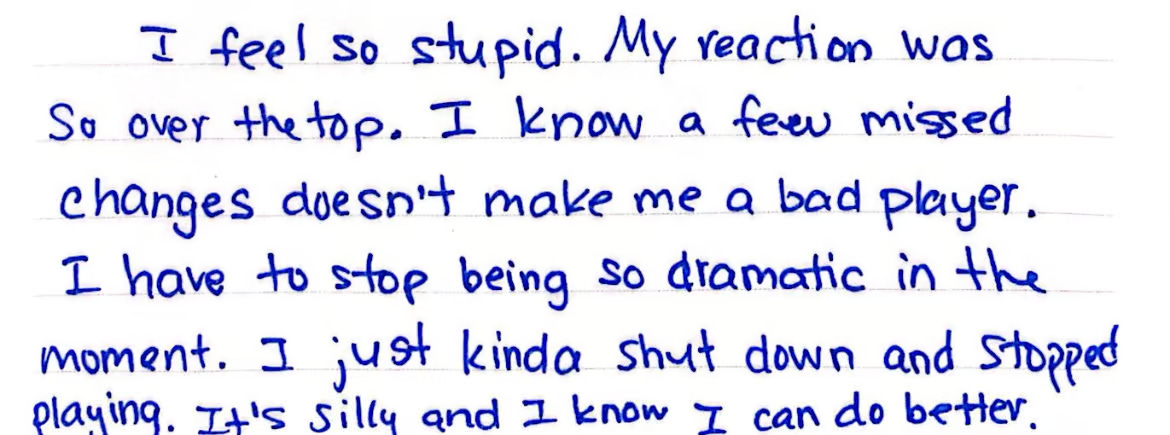
This player hadn’t even considered how out of step her thoughts were with reality. Years of negative self-talk had trained her to catastrophize moments that didn’t deserve it.
She went on to have a successful Division I career. And it started with recognizing that the gap wasn’t between her talent and the college level - it was between what she believed was happening and what was actually happening.
The NIT application
Here’s how this shows up at recruiting tournaments:
After Game 1:
A: I missed a few passes, didn’t get many touches
B: Coaches saw me play terribly. My recruiting is probably over.
C: I play timid the rest of the weekend, don’t demand the ball, make it worse
The reality? Coaches are watching 12-14 games per day across multiple courts. They’re building a picture of each recruit over multiple events across a couple of years.
If you aren’t at their level anyway, having one of your best games, unfortunately, probably won’t change that.
But if you are at their level, one rough game won’t end it. They’ll likely put it down to a bad outing and come watch you again.
But none of that matters if you let the thought from Game 1 destroy the rest of the tournament.
The performance anxiety becomes the performance problem.
The tactical move
You’re not going to journal between games at a busy tournament. But you can catch the thought before it spirals.
When you walk off the court after a tough game and your brain starts telling you it’s over - stop. Ask yourself: “Is this a fact or a story?”
Fact: I had three turnovers in the first half
Story: My recruiting is over
Fact: I didn’t get many touches
Story: Coaches think I’m terrible
Fact: That game didn’t go well
Story: I always choke at recruiting tournaments
Then go play the next game based on what actually happened, not what you’re afraid it means.
After the tournament
Once NIT is over, use the ABC framework to debrief the whole weekend:
Step 1: Write down what happened. Be specific about the tournament. “I played five games. Two felt good, three were rough. I had more turnovers than usual in Games 1 and 3.” Not “The whole tournament was a disaster.”
Step 2: Write down your belief. What story are you telling yourself about the weekend? “Coaches saw me struggle. They probably think I’m not good enough. This tournament hurt my recruiting.”
Step 3: Challenge the belief. Is this based on facts or assumptions? “I don’t actually know which games coaches watched. I don’t know what they thought. I’m assuming the worst without any real information. The turnovers happened, but I don’t know if that’s what they were even looking at.”
When you write it down, you’ll usually realize the story you’re telling yourself is based on assumptions, not reality.
The consequence is still yours to control. You can let the belief spiral and pull back from recruiting.
Or you can use the tournament as a roadmap: work on the decision-making that caused the turnovers, focus on lifting your energy after mistakes at the next event, email coaches with your spring schedule.
The adversity happened. What you do next matters more.
The bottom line
You can’t control what coaches think. You have almost no information about where you stand in recruiting until June 15. That asymmetry creates anxiety.
But you can control whether that anxiety creates worse performances at the exact moments that matter most.
The ABC framework helps you separate what happened from what you think it means - before the thought becomes the consequence.
We can all learn how to talk to ourselves instead of listening to ourselves.